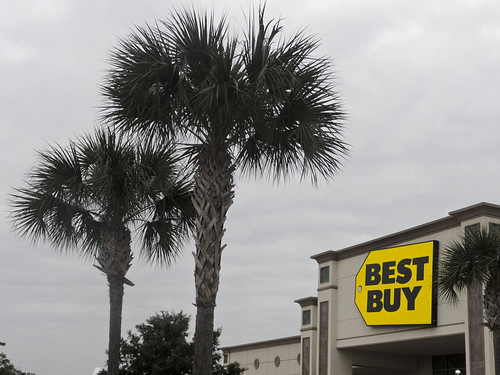

One of the key secular growth trends set to dominate retail over the next few years is the transition from bricks and mortar sales to online sales. Another, more cyclical, theme relates to the unequal nature of the economic recovery. Put simply, emerging market demand is pushing up the price of those goods that the lower income groups spend a larger part of their discretionary income on. So with higher food and energy prices there will be less spend on consumer discretionary for lower income groups.
Putting these two themes together, it is not hard to see that businesses like Best Buy $BBY, Family Dollar $FDO and Dollar General $DG should be structurally challenged. Indeed, Best Buy gave Q4 results recently and it disappointed the market with its outlook and guidance. However, the likes of Nordstrom $JWN and Coach $COH (Japan aside) have been demonstrating good growth. Moreover, companies like Amazon $AMZN and Walmart $WMT are key beneficiaries because they both can grab market share from the likes of Best Buy.
What Best Buy Earnings are Telling the Market
Best Buy gave numbers and guidance
- Full Year Guidance of $3.30-$3.55 vs. $3.56 estimates
- Q4 revenue decline by 2%
- Same stores sales decline of 4.6% partially offset by new store growth!
- Gross Margin expansion
Clearly, Best Buy has some issues to deal with and the company was quick to cite disappointing sales of higher margin TV sets and net book sales. Moreover, declining sales has had an effect on inventory and analysts were quick to focus on the rising inventory plus working capital requirements. High inventory is a problem because it implies a reduction in future margins (to shift slow moving stock) and it also raises question about the structure of the business.
| ($m) | 2008 | 2009 | 2010 | 2011 |
| Revenue | 40,023 | 45,015 | 49,694 | 50,272 |
| Inventory | 4,708 | 4,753 | 5,486 | 5,897 |
| Revenue/Inventory | 8.50 | 9.47 | 9.06 | 8.53 |
So we see that the revenue/inventory ratio is rising. This is not usually a good sign.
The Case for Making Best Buy a Best Buy?
The positive case for Best Buy is best made with reference to its evaluation and restructuring program. The decline in sales could be seen as a result of an unfavourable product sales mix (TVs, net books, lack of new upgrade cycles for windows) and the difficulty of beating tough comparable sales. There is no doubt that Best Buy is generating huge amounts of free cash flow and it is capable of using this cash to generate EPS growth via share buy backs. Indeed, current analyst (and company) estimates do not account for buy backs. More importantly, Best Buy is generating the cash in order to restructure the business.
The restructuring program centres on shifting sales towards things like Best Buy Mobile, tablets and gaming. In addition, Best Buy is reducing the size of stores in the US so the possibility exists for an increase in sales per square foot as well as learning how to maximise sales in new stores. Gross Margins rose in these results and the company has been aggressively controlling SG & A costs. Initiatives like ‘buy online pick-up in store’ are intended to differentiate Best Buy from online only competition and are reflective of how Best Buy is competing.
We can see these issues reflected in gross margin growth which has been in sequential decline.
| ($m) | 2008 | 2009 | 2010 | May-10 | Aug-10 | Nov-10 | Feb-10 | 2011 |
| Revenue | 40,023 | 45,015 | 49,694 | 10,787 | 11,339 | 11,890 | 16,256 | 50,272 |
| Gross Profit | 9,546 | 10,998 | 12,160 | 2,793 | 2,918 | 2,983 | 3,943 | 12,367 |
| Gross Margin | 23.9% | 24.4% | 24.5% | 25.9% | 25.7% | 25.1% | 24.3% | 24.6% |
However, on a yearly comparison Q4 gross margins were actually up.
Best Buy a Structurally Challenged Stock?
The negative case centres on the argument that-despite the cheap evaluation-Best Buy is structurally challenged and these issues will see a future decline in earnings and cash flow generation. For example, a comparable retailer in the UK is HMV (cds, dvds, games etc) and this company looked very cheap for a long time on traditional evaluation metrics. However, the share price continued to decline with ongoing structurally challenges. This is a significant point because Best reported that European sales growth and gross margins were negative. As HMV went, so could Best Buy. Indeed, many of Best Buy’s initiatives are focused on restructuring to face the online threat, but is the company capable of meeting these challenges?
For example, reducing store size is wonderful, but it implies reduced sales of ‘bulky’ products and these products tend to be those sold in store. Retailers tend to buy IP based purchases online and it is this type of purchases (mobile, tablet, gaming etc) that Best Buy think it can expand into. Furthermore, opening new stores when existing sales are in decline is usually a bad move in retail. It suggests that the company will be implementing more of a failing business model or sales mix.
Similarly, new technological developments like customers being able to scan barcodes and search online for cheaper alternatives will challenge Best Buy margins and sales growth. Moreover, online retailers specialise in ‘long tail’ provision, so if Best Buy wants to compete with them they will have to hold larger inventory and that will eat into cash flow generation.
Essentially, new technologies and ‘convergence cannibalisation’ (ex cameras, computers, phones, ipods merging into a single device) from companies like Research in Motion $RIM and Apple $AAPL are challenging retailers like Best Buy. Unfortunately, this comes at a time when discretionary spending in middle income America is being pressured by high food and energy costs.
Whilst Best Buy Mobile sales growth is good, this could be seen as being driven by a cyclical uptake of things like smart phones of which Best Buy is not particularly well positioned to take advantage of for follow up sales.
Is Best Buy a Stock to Buy?
On balance, I think not. The stock trades at $29.22 and has an EV of $13.45bn. I think that history shows us that despite the superficial attractions of a high free cash flow yield (above 10%) and low P/E ratio of 8.8x the structural trends against this business are significant. I would look for a fall in comparable sales to revenues ratios before considering a long term purchase of this stock. For short term investors, I suspect that given improved macro-economic fundamentals there is some upside here because investors will like the evaluation-after all every stock has a price- but I think the challenges for Best Buy will accelerate and, I place little confidence in the forecast estimates.