This blog is devoted to helping investors make informed decisions. It will be regularly updated and provide opinions on earnings results. It is not intended to give investment advice and should not be taken as such. Consult your investment advisor.
Check Point Software Technologies Ltd delivered good second-quarter results on Tuesday, but lowered revenue and earnings estimates for the coming quarters. Let's take a look at the results and the nuances behind management's commentary.
Following fellow IT security company Fortinet Inc.'s near-20% drop after it reported results last Friday, investors in Check Point Software Technologies Ltd.
must have had a nervous weekend waiting for earnings on the following
Monday. In the end, Check Point's third-quarter earnings were fine, but
the real question is: What will happen in the fourth quarter?
IT security company Check Point Software's (NASDAQ: CHKP)
latest results confirmed a return to form, thanks to its product sales
growth finally turning positive after three quarters of declines.
However, they also highlighted how competitive its end markets are. With
its revenue growth having slowed to low-single digits, this company is
now firmly in the mature cash-cow phase of its evolution. Is there a
case to be made for buying the stock?
Check Point maturing in a tough market
The IT
security market has unquestionably gotten tougher over the last few
years. As the incumbent leader in the market, Check Point has had to
deal with encroaching competition from the likes of Palo Alto Networks (NYSE: PANW) and Fortinet (NASDAQ: FTNT)
. Palo Alto, a company founded by an ex-Check Point employee, has
stepped up competition with Check Point in the high-end firewall market.
Meanwhile, Fortinet, a company whose traditional strength lies in the
small and medium-sized business market, has been successful in increasing its deal size as it becomes increasingly relevant to larger corporations.
Consequently, Check Point has been squeezed at both ends, and its
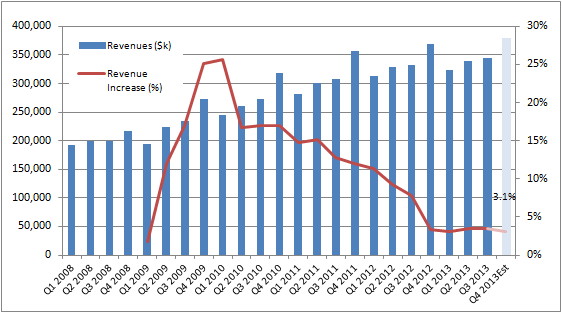
growth has slowed accordingly. The latest third-quarter results saw
revenue growth at just 3.5% and the guidance for fourth-quarter revenues
of $365 million to $395 million implies growth of just 3.1% at the
mid-point.
Source: company accounts
5 reasons to be optimistic
A tech stock with low
revenue growth isn't usually seen as an attractive proposition by the
market. However, in Check Point's case there are four key positives from
its third-quarter report.
Even though Check Point tends to bundle its software blades with its
hardware products (so the hardware/software split is somewhat inexact),
the return to product sales growth is still a good indicator because it
suggests the installed base is increasing. In other words, Check Point
should be able to sell add-on software blades in future to its new
hardware customers.
Second, the company has successfully opened up new markets. Its new
low-end 600 and 1100 series (aimed at the SMB market where Fortinet is
strong) saw sales grow 40%. In addition, its high-end data center based
sales (the 13500 and 21000 series) performed extremely well this quarter
with healthy growth.
Third, its underlying metrics have improved. When Check Point takes a
customer on board it books revenues for the products, and also bills
for the full service contract. The service revenues are then recognized
incrementally as the work is done. Therefore, investors should look at
revenues and the change in deferred revenues to better gauge how it is
performing.
For the first time in a year this metric turned positive.
Source: company accounts, and author's analysis
The final point is that its guidance of $365 million to $395 million
looks a little conservative. At the mid-point it represents just 10.4%
sequential growth when the last five years have averaged 13.7%
sequential growth.
Where next for Check Point Software?
Palo Alto
Networks gave results in September and they also confirmed that the
security market remained healthy by predicting that next quarter's
growth would be 37% to 42% on a yearly basis. Meanwhile, analysts have
Check Point on low to mid-single digit revenue growth rates for the next
few years, with EPS growing around 7.3% next year.
By my calculations Check Point has just generated $925 million in
free cash flow (representing around 9% of its enterprise value) and this
holds the key to its future. With over $1.2 billion in net cash , it
has plenty of options in terms of initiating return cash to shareholders
(dividends or more buybacks) or making growth enhancing acquisitions or
investments. I suspect that with any of these initiatives in place, the
stock will be rerated. However, it's one thing to hope something will
happen, and it's another to see it.
In conclusion, Check Point looks undervalued and its underlying
trading performance has improved, but you get the feeling its management
could do more.
The most surprising thing about Palo Alto Networks'(NYSE: PANW)
recent results were that the market was surprised by them. In truth it
has been a difficult first quarter for technology companies, and despite
having defensive characteristics (IT security threats are definitely
not going away) its sector hasn’t been oblivious to the difficulties. In
summary Palo Alto missed estimates and guided lower than the market
consensus with the usual concerns over Europe and Government coming to
the fore.
Palo Alto gives little succor
Probably the most interesting aspect of these results was the timing. Its security rivals like Check Point Software (NASDAQ: CHKP) and Fortinet (NASDAQ: FTNT)
had already given weaker than expected results amid talk of customer
hesitancy (partly due to sequestration fears) and a faltering macro
environment. If this was to prove temporary then we might have hoped
that Palo Alto would report better conditions given that it is already
June. Unfortunately it intimated that things got worse in April (the
back end of its quarter), and performance in May was only ‘in line’ with
its adjusted guidance.
Here is a chart of Palo Alto’s performance.
Note that product revenues saw a sequential decline in the quarter,
and while the revenue guidance for Q4 of $106 million to $108 million
implies a near 43% rise in revenues (at the mid-point), it is below the
market estimates of $113.7 million. On such things do tech stocks soar
and crash.
To put this into context, Fortinet had already warned, and as articulated in an article linked here,
it will have to see a bounce back in the second half in order to hit
even the lowered guidance. Palo Alto’s recent statements would not
suggest that underlying conditions have improved much so I would suggest
taking Fortinet’s word (that Q2 would be similar to Q1) at face value.
In addition Fortinet stated that its service provider revenues were weak in the quarter. This is a similar story to what F5 Networks (NASDAQ: FFIV)
outlined over its application delivery controller based revenues too.
The good news for Palo Alto is that, although it did see some ‘softness
on its service provider based revenues, they do not make up a
significant part of its overall revenues.
What caused the miss?
It is really about sequestration effects and Europe, specifically
Southern and Central Europe. Palo Alto saw a $3 million-$4 million
shortfall in sales from this region. Overall EMEA sales declined 4% on a
sequential basis. As for federal work the weakness seen
was largely a consequence of sequestration effects. We can also see
these effects on federal spending in a detailed look at F5 Networks' recent results. With regards to F5 specifically, I note that Citrix Systems
had a pretty good quarter with its rival product, and since F5 is
undergoing a product refresh there may be other factors at play here.
With regards to competition there were a couple of interesting points made in the conference call. Firstly,
Palo Alto’s management doesn’t feel that ‘bundling’ will get the job
done anymore. I suspect this is a reference to competitors like Cisco Systems or Juniper Networks who
may well try to include security solutions as part of their networking
offerings. Indeed, Cisco’s security revenue growth turned negative in
the last quarter.
Second, there were the usual references to beating out Check Point
and others in the presentation. As a young and fast growing company we
should expect Palo Alto to be replacing the installed base of
competitors, but in retrospect Check Point’s recent results were
relatively good, and there are some signs (average selling prices
rising) that it is getting over the hump of convincing its customers to
buy its upgraded products.
Where next?
It’s hard to be overly positive because it would have been useful if
Palo Alto had reported better conditions in April/May but, the fact is
that they did not. With that said the bullish case sees the
sequestration effects as causing some short term reactions, much of
which will be ironed out later in the year. Sequestration has its most
obvious influence on public expenditure, but it will also affect the
private sector because the former uses the latter. However, once the
fear of the unknown recedes then companies like Palo Alto and Fortinet
can hit their revised guidance.
The bearish case argues that these effects will continue to slowdown
the IT market as the knock-on effects ripple through the economy and
guidance will have to be lowered for many of these companies. Meanwhile
the situation in Europe is hardly looking much better with sovereign
debt issues remaining at the forefront of concerns.
Since we have never had sequestration before, it is hard to know
which approach to take! My gut feeling is that things won’t get much
worse. Unemployment is falling in the U.S., and growth is moderate but
constant, while the housing market is picking up. F5 Networks has some
uncertainty about it and Check Point needs to demonstrate it can get
back to product revenue growth. However, if you are going to buy Palo
Alto and Fortinet then this could be a decent time to start thinking
about picking some of these names up.