Showing posts with label deere. Show all posts

Sunday, December 28, 2014

Deere & Company (DE) Earnings Call


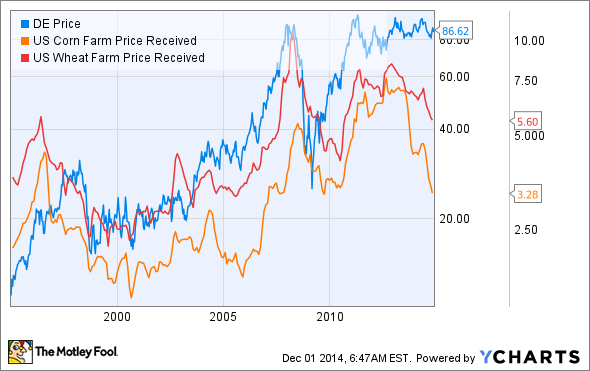
Deere & Company (NYSE: DE  ) recently beat fourth-quarter estimates, but served notice that 2015 is likely to be a tough year. It's hardly surprising given the price weakness in key crops like corn, wheat, soybeans, and cotton. Ultimately the company's fortunes will be tied to the cyclicality of the farming sector, and investors should follow events closely because a potential turnaround in crop prices will likely lead to the stock moving higher. However, before you rush to take a view, here are five things management thinks you should know.


DE Chart
DE data by YCharts

Deere & Company guidance disappoints; farmers' cash receipts seen as key

In a nutshell, management guided toward a decline in net sales of 15% mainly due to a forecast 20% net sales decline in its agriculture and turf segment.


READ THE FULL EQUITY RESEARCH ARTICLE LINKED

Wednesday, September 24, 2014

Is Deere a Stock to Buy?

Agricultural and construction machinery manufacturer Deere  represents one of the most compelling investment ideas in the industrial sector right now. However, it's not going to be an easy decision for you. The long-term demand for food (more than 80% of Deere's sales are in its agriculture and turf segment) remains in place, but the company also faces significant near-term risks from declining food prices. What's an investor to do?


Source: Motley Fool Flickr.


Deere's upside and downside drivers
Before focusing on answering this question, readers may be interested in referencing other articles in this series. For example, a review of the recent results here highlights the deterioration in the company's agricultural sales; a review of the five key takeaways from the earnings conference call can be found here; and articles making the making the bullish and bearish cases for the stock can be found here and here.


Turning back to question in my lead, the answer is "no" and "yes." No one said buying and selling stocks was easy!


READ THE FULL ARTICLE LINKED HERE

Wednesday, September 3, 2014

Why Deere's Stock Could Fall

Having recently disappointed the market with its guidance, investors will be wondering if Deere's (NYSE: DE  ) fortunes have now hit a trough and are about to turn up, or whether the stock has further to fall? The purpose of this article is to look at the three downside risks, so investors can make an informed decision as to whether they want to buy, hold, or sell the stock.


Deere equity research
This article is part of an ongoing series on the company, intended to give readers a balanced viewpoint. Fools have already read a summary of Deere's recent earnings linked here. Essentially, full-year expectations for net income and equipment sales were reduced in the earnings report, as the Deere's agricultural machinery sales are taking a hit from weak crop prices. There is a summary of the five key takeaways from the conference call linked here, and a look at potential upside drivers linked here.


READ THE FULL ARTICLE LINKED HERE

Saturday, August 30, 2014

What Deere's Management Wants You to Know

After a disappointing earnings report that saw the company lowering its full-year income and equipment sales expectations, Deere & Company's (NYSE: DE  ) management was obliged to outline how it would deal with weaker conditions. Current conditions are difficult in the farming machinery industry; but what is Deere doing about it? It's time to look at the five key takeaways from its third-quarter conference call.


Deere's end markets getting weaker

As Fools can read about here, Deere's latest earnings report produced a downgrade to sales expectations in its core agriculture and turf segment -- 81% of sales year to date. Essentially, the problem is that weak crop prices are lowering farmers' profits and encouraging them to hold back on purchasing farming equipment.


While lower crop prices are likely to impact farmers everywhere, the first takeaway relates to some specific commentary on China in both agriculture and construction. This is something that investors in Caterpillar  should follow closely, too.


READ THE FULL ARTICLE HERE

Friday, August 29, 2014

Deere Earnings Analysis

Deere & Company (NYSE: DE  ) delivered an acceptable set of third quarter results, but its guidance was disappointing and, on balance, the earnings report was a net negative. In common with many of its peers, Deere is seeing an ongoing divergence in prospects between its agricultural and construction based operations. The former is suffering due to falling agricultural prices, while the latter is gaining traction with an improving construction outlook.


Unfortunately, Deere's revenue and profit is heavily skewed toward the agricultural sector. For example, more than 81% of its equipment sales came from its agricultural and turf segment, with the remaining 19% coming from its construction and forestry segment. It's time to look more closely.


Source: Motley Fool Flickr Account

Deere's third quarter results


A quick summary of the key numbers in the earnings report:


READ THE FULL ARTICLE HERE

Tuesday, June 24, 2014

AGCO Faces a Difficult Year, but is the Stock a Buy Anyway?

Investing in agricultural machinery company AGCO Corporation  doesn't appear to be rocket science to many investors. In common, with rivals like Deere & Company , the stock's direction is usually dictated by movements in key farming commodity prices. At the same time, investors should be open-minded to buying when others think prospects are gloomy. So, with the stock in negative territory over the last year, is now the time to buy AGCO?

Near-term risks remain
Simply put, no one likes buying a stock with deteriorating earnings, and analyst forecasts are for AGCO's earnings to decline over the next two years.

Moreover, there are three reasons why AGCO faces near-term risk.

First, despite weakening market conditions, AGCO kept its outlook unchanged in the first quarter. This raises the fear that it will miss estimates going forward. Its full-year revenue guidance of $10.8 billion-$11 billion, and full-year EPS guidance of $6.00 was left unchanged, even while there has been some weakness in South America (19% of sales in 2013). Its South American sales declined 9.3% on a constant currency basis in the first quarter, and its rival Deere & Company also saw weakness that caused it to lower its full-year guidance for South America and the CIS countries.


Sunday, June 22, 2014

Why Deere is a Better Value Than Caterpillar

Investors often obsess over the short-term profitability of an equity, rather than considering the bigger picture of how the stock will work in their portfolios over the longvterm. Such thoughts spring to mind when I consider buying Deere & Company instead of a peer like Caterpillar . In short, Deere is facing a number of short-term negatives, but there is a growing case for buying the stock as a long-term hold.


Caterpillar and Deere, a tale of two markets
Any analysis of these two stocks will show that they tend to be highly correlated, but that doesn't mean they will be so in the future. Simply put, Caterpillar is much more of a play on construction and resources, with the two segments combining to generate 58% of product revenue in its first quarter. Meanwhile, Deere is more focused on agriculture and turf, which made up 83% of its machinery sales in its recent second quarter.


While, construction, mining and agriculture tend to be cyclical industries, there is no specific reason why they must all operate within the same cycle. However, investors don't always see it that way. Indeed, Deere and Caterpillar are often seen as de-facto plays on global growth, and in particular in China.


The idea being that the growing middle class in emerging markets will create more food demand, particularly for protein, which in turn demands more feed production. Meanwhile, the same growing middle class will demand more construction activity and therefore mining materials.


Tuesday, March 4, 2014

What you Need to Know About Deere

The agricultural sector hasn't said many positive things in recent weeks. Not only are investors fretting over deteriorating conditions at agricultural machinery distributor Titan, but Deere also recently outlined its expectations for a 3% decline in sales in 2014. Moreover, CNH Industrial  gave news of its expectation of a decline in demand for its agricultural machinery in 2014. In fact, the only good news -- more relevant to a company like Caterpillar within the sector -- is that the construction machinery outlook is improving. So, where does all this leave Deere as an investment proposition? It's time to look at three key factors affecting the stock.

READ THE FULL ARTICLE LINKED HERE

Friday, December 20, 2013

Time to Get Bullish on Toro?

The logic is simple: if you buy the housing recovery, then you should buy a recovery in spending on landscaping and gardening. In other words, companies that make landscaping equipment like Deere   or Briggs & Stratton  should be on your radar screen. If you also like the demographics behind golf, then a stock like Toro   will loom large in your thinking. It's time to take a closer look at all three.

Bullish on Toro
A quick look at its revenue by geography shows that 70% of Toro's revenue comes from the US, with Europe providing 12% and Asia 4%. In other words, Toro is still very much a North American play. Furthermore, a breakdown of its segment revenue demonstrates that golf landscaping, residential gardening, and professional landscaping are its key end markets.

 
Essentially, Toro is a cyclical stock but there are good reasons why it can outperform in the current environment.
First, its residential lawn and garden segment is obviously tied to the housing market. Since this sector of the economy was at the epicenter of the crash, it's reasonable to expect it to behave in a super-cyclical fashion in the recovery.
Indeed, Home Depot and Lowe's have both reported stronger sales of garden equipment this year. Meanwhile, in October, Briggs & Stratton reported quarterly retail lawn and garden sales growth of approximately 50%. Although much of this is due to an easy comparison with last year's drought conditions, it's still a hefty increase.
Second, Toro's professional landscape and grounds business should see a lift in the future from new home construction. As new communities get built, the demand for amenities and infrastructure will go up as well. Indeed, Toro's management made some bullish noise on this segment in its recent conference call:
Toro continues to be added to many states and local government contracts. This helped increase our professional grounds business sales in 2013 and should bode well for business in 2014.
Deere may well have agreed to sell a 40% equity interest in its landscape business, but this is because the company is refocusing on its core agricultural business rather than a negative statement on the landscaping market.
Toro's profit-drive down the fairway
The third major revenue center is probably its most interesting. Golf is traditionally seen as a higher-income earner's pastime. While it's discretionary in nature, it's also affected by the weather. For example, there was a 5.7% increase in US golf rounds reported from 2011 to 2012 (in-line with an improving economy).  
However, in its recent results, Toro's management outlined that US rounds played for the year only declined 5%, even as there were 6.7% less days open for play due to poor weather. This implies that golfers are playing more rounds, and should weather improve next year, Toro could see some favorable comparisons.
Overall, it's fair to say that Toro's prospects -- and particularly those of golf -- are tied to movements in mean household income. For example, here is a chart of Toro's revenue versus US household income for the highest one-fifth. Note that the income numbers are in current dollars (what was recorded at the time), when in 2012 the dollars equivalent figure is actually down 4.1%. This is done because Toro's sales figures will be in current figures too.

Source: US Census of the Bureau, Toro presentations
It's a pretty strong correlation, although Toro probably saw some stronger years in 2003-2006 thanks to the housing boom. It also saw a far more severe downturn in 2009 as the world looked set to implode.
Revenue for 2013 came in with a 4.2% increase after 4% in 2012. Moreover, Toro is forecasting 4%-5% revenue growth for next year; all of which suggests that Toro is a business whose top-line growth equates closely to nominal GDP and income growth, albeit with more downside exposure should the economy fall back.
The bottom line
Toro's forecast revenue growth appears uninspiring, but it has some upside potential if the housing market strengthens. In addition, a cold winter snap will -- in common with Briggs & Stratton -- provide some upside for its snow blowers.
However, while both stocks look to be decent plays on economic growth in 2014, it's harder to make a case that either is a good value pick.
BGG PE Ratio (Forward) Chart
On a forward P/E ratio basis, Briggs & Stratton looks to be a better value. However, on a risk/reward basis, it's hard to make a case for Toro right now. Waiting for any kind of pullback seems to be a sensible strategy.