Showing posts with label fastenal. Show all posts

Monday, March 28, 2016

4 Stocks Flying in 2016

It's been a difficult first quarter for the industrial sector, with China's growth slowing, talk of an industrial recession in the U.S., and the European Central Bank cutting interest rates to stimulate Europe's economy. Yet somehow, industrial supply companies MSC Industrial Direct Co. (NYSE:MSM), Fastenal Company (NASDAQ:FAST), and W.W. Grainger Inc. (NYSE:GWW) are up an average 16% in 2016. What's going on, and can it continue?

KMT Chart
KMT data by YCharts.

READ THE FULL EQUITY RESEARCH ARTICLE LINKED


Thursday, December 31, 2015

5 Key Indicators for the Industrial Sector

While we don't believe in macroeconomic speculation at the Motley Fool, we admit that sometimes key insights into a company's prospects can be explained by looking closely at an industry or macro economic indicator. After all, it's hard for even the best company to fight against strong economic tides. With that in mind, the information in the following 5 charts give a rough idea of how the underlying industries of the 5 companies in question might fare in the year ahead.

READ THE FULL EQUITY RESEARCH ARTICLE LINKED

Sunday, May 4, 2014

What the Industrial Supply Companies are Saying About the Economy

Investors in the industrial sector have faced a significant imponderable over the winter. Severe weather conditions were always going hit quarterly earnings, but they were also going to make it harder to judge the underlying conditions in the industrial economy. With these thoughts in mind it's a good idea to look at industrial supply companies such as Fastenal , MSC Industrial Supply, and WESCO International. Not only are they all exposed to the industrial sector, but they tend to have short-cycle order patterns. In other words, they get the first view on where trends are headed.

Fastenal and MSC Industrial give earnings
At the start of this earnings season, Alcoa came down on the side of those who saw the weather as the primary cause of weakness in the construction industry over the winter. The subsequent results from MSC Industrial and Fastenal offer a pretty similar story. For example, MSC's management talked of a weather-relate "slow start" in December and January, but then its organic growth rate picked up from 2%-3% to "the mid-6% range in February." 

Fastenal's improvement in March can clearly be seen by looking at sales growth at its stores that have been open for more than five years:


Wednesday, March 12, 2014

Illinois Tool Works Equity Research

Illinois Tool Works is always one of the most interesting industrial companies to follow because it has broad exposure to the industrial economy. In particular, Foolish investors in peers like Johnson Controls Inc.  and 3M Company should take note, while Fools invested in industrial supply companies like WESCO International Inc.  and Fastenal Company will surely have an interest, too.

How Illinois Tool Works makes money
A quick look at Illinois Tool Works' revenue by end market reveals how diverse its end-market customers are. Even within the automotive segment, it sells into a mix of original equipment manufacturers and aftermarket customers. It's a similar story within its construction (residential, commercial, and renovation) and its food (institutional, service, and retail) sales, too.
 

Saturday, January 25, 2014

Is Fastenal Good Value?

Last year was a difficult one for investors in industrial supply company Fastenal  $FAST . The stock ended the year flat, and managed to underperform sector peers such as Grainger $GWW  and MSC Industrial  $MSM. Furthermore, the Institute for Supply Management, or ISM, manufacturing data got a lot stronger in the second half, but Fastenal's performance did not. What's going on? Can the market expect more from the company this year?

Fastenal disappoints, again
Having warned investors that it would miss quarterly earnings per share estimates of $0.36  in its update in December, Fastenal then managed to miss its upgraded estimate of "growth in net earnings per share" by reporting flat earnings growth of $0.33 for its fourth quarter.

Superficially, this is surprising given the strength of the ISM manufacturing data:


Source: Institute for Supply Management

In addition, MSC Industrial's management reported on its January conference call that feedback from its manufacturing customers "confirms the current theme of stabilization and gives us some cause for greater optimism about 2014."

So why did Fastenal miss esimates?

Fastenal adjusts its sales operations, gets heavy too
In the December update, Fastenal outlined the three reasons for the earnings miss.

First, despite the strong ISM numbers, Fastenal is having some issues with its particular end markets. The company generates 50% of its sales from manufacturing, 25% from non-residential construction and the rest from a diverse set of business. Within its manufacturing sales, heavy manufacturing makes up 80% of sales with heavy equipment making up half in turn. Be sure to distinguish between Fastenal's heavy manufacturing and its heavy equipment sales, the latter is a subset of the former.

All told, heavy equipment makes up 20% of total company sales and this segment was weak in 2013. In fact, Fastenal disclosed that heavy equipment sales (agriculture, mining, construction, defense, etc.) grew less than 2% in the third quarter, and only 1.5% in the fourth, even as heavy manufacturing sales were up "between 6% and 7%". The good news is that heavy manufacturing sales appear to be recovering (in line with the ISM) with a 7.2% in the fourth quarter following a 5% gain in the third.

Indeed, the theme was confirmed by MSC Industrial's management on its recent conference call: "Overall, we continue to see that our core customer segments in heavy metalworking are still lagging the broader industrial economy." Grainger also reported that its light manufacturing sales grew in "the high-single digits" in the third quarter, but its heavy, commercial and natural resources sales were only up "mid-single digits". 

In addition, Fastenal's sales to non-residential customers have been weaker in 2013, as poor weather plus sequestration issues hit the commercial and industrial construction markets.


Source: company presentations.

Second, gross margins ran below expectations. According to Fastenal's  December update, this was due to "lower utilization of our trucking network and lower supplier incentives", and "the final components relate to product mix (fasteners carry our highest gross margin and have had a weak 2013) and a very competitive marketplace".

In fact, fastener sales started 2013 by comprising 42.9% of total sales, but only made up 40.6% at the end of it.  However, on the recent conference call, Fastenal's management outlined that gross margin is expected to get back to its historical 51%-52% range in the first quarter, recovering from a disappointing 50.6% in the fourth quarter of 2013.

The third factor was due to the expansion in store headcount made in the second half. Earlier in the year, Fastenal had outlined a plan to hire 600-900 more in-store staff in order to enable existing managers to increase their sales visits. In addition, there was a change of approach whereby the company went for quality over quantity with the expansion of its vending machines; a policy set to be reversed in 2014. It appears that the sales changes caused some initial problems, and Fastenal's management was quite upfront on the failure to execute in the second half.

Where next for Fastenal?
It's a mixed outlook for Fastenal.

On the positive side, 2014 it could be a better year for commercial construction, and the new orders component of the ISM manufacturing index (see above) indicates that manufacturing growth will be strong in the coming months. Furthermore, its gross margin looks set to bounce back, while its sales execution has the potential to improve.

On the downside, the stock remain expensive related to its peers:

FAST EV to EBITDA (TTM) Chart


Moreover, Grainger and MSC Industrial have the potential to grow their e-commerce revenues and vending machine sales, while sales to customers with vending machines already  make up 36.6% of Fastenal's  net sales.

In conclusion, the U.S. industrial sector looks like it will be healthy in 2014, and Fastenal is likely to bounce back, but there are cheaper ways to buy into the sector than this. The valuation is still not compelling.

Tuesday, October 8, 2013

This Week's Key Earnings

The symbolic start to the new earnings season takes place this week when aluminum producer Alcoa (NYSE: AA  ) gives results. It's going to be a very interesting season of results, and the key stocks this week should give good color on certain sections of the global economy.

Tuesday

Alcoa always gives good guidance on the global economy, and last quarter's report was quite positive. In fact, the surprising thing was that it maintained its outlook for China, even while companies like FedEx have been lowering their global growth forecasts throughout the year.  Furthermore, FedEx recently lowered its U.S. GDP forecasts inline with economists' thinking. All of this suggests that an economically sensitive company like Alcoa could lower some of its end-market forecasts. We shall see. 

Two important things to look out for are its outlook for the Chinese automotive sector, and the U.S. building and construction sector. Here are the growth rates for automotive sales and production in China. 


Source: China Association of Automobile Manufacturers.

Production rates have been strong in the last few months, but production has outpaced sales throughout 2013. So is it time for a moderation in production growth?

Turning to the U.S. construction and building sector, the architectural building index has perked up in recent months. It will be interesting to see if Alcoa upgrades its expectations accordingly.


Source: American Institute of Architects.

The second key report on Tuesday will come from Yum! Brands (NYSE: YUM  ) . All eyes will be on its outlook for KFC same-store sales in China because it has lost a lot of ground thanks to fears over its chicken supply quality in China, and then an outbreak of avian flu in the spring.


Source: company presentations

The good news is there are some signs that the worst is over. First, on its last conference call, Yum! pointed out that its July same-store sales declined 13% versus a 26% decline in the second quarter. Furthermore, McCormick (a spice and seasonings company that is a major supplier to KFC) stated that its sales to quick-service restaurants in China were "better than we had expected." This is a good sign for Yum!'s earnings.

Wednesday

The attention shifts to the U.S. retail scene on Wednesday when big-box retailer Costco Wholesale (NASDAQ: COST  ) and discounter Family Dollar Stores  (NYSE: FDO  ) release earnings.

It's been a tricky year for U.S. retailers as consumers seem highly responsive to pricing and promotions. The pattern appears to be that retailers hike prices only to be met with a drop in volumes; then they are forced to take action to regain market share. Then the cycle is repeated.

However, Costco stands out because it has managed to generate sales growth, as well as margin expansion.


Source: company presentations.

The key things to look out for with Costco are its new membership signups and whether traffic and frequency (the rate that its customers return) remain in growth mode.

Turning to Family Dollar, its forecasts for the upcoming results are that same-store sales growth will come in at 2% and gross margins will be flat. The latter is somewhat of a victory because its margins have been under pressure due to its expansion in sales of lower-margin items such as tobacco and groceries.  

However, the key thing to look out for will be its core discretionary sales. At the last results, Family Dollar spoke of some stabilization in these sales. Discretionary sales at the dollar stores tend to be higher-margin items. Unfortunately, the dollar stores have struggled to deliver consistent discretionary sales growth in a difficult economy. Have they turned the corner?

Industrial-supply company Fastenal (NASDAQ: FAST  ) also reports Wednesday. The company has long been a good barometer for U.S. industrial conditions, and investors would do well to listen carefully to what it says.

The key thing to look out for with Fastenal will be how its plan to recruit 600-900 new in-store staff by year end is transgressing. The idea is that the new support staff should free up time for its managers to make more customer visits and help expand sales. Interestingly, Fastenal reported that its stores open for more than five years had sales growth of 0.6% in July, and then 4.7% in August. This implies that the plan is starting to work, and investors will want to see more improvements in September's numbers as well as some positive news on U.S. industrial conditions.

Wednesday, August 7, 2013

PPG Industries is a Stock to Buy

Investors in paintings and coatings company PPG Industries (NYSE: PPG) have enjoyed a nearly 45% rise over the last year, but the stock has remained in a tight $150-$160 range over the last few months. Is this a sign that it’s time to take profits on the stock?  Before you rush to hit the sell trigger, you should consider the upside potential in this stock. PPG can move higher in 2013, and here is why.

End market conditions

PPG’s prospects for 2013 will largely be governed by its performance within the industrial and architectural/construction end markets.

With regard to the industrial sector, it’s been a mixed earnings season so far. As a general rule, companies exposed to sub-sectors such as aerospace and automotive have done really well, while the rest of the industrial sector has faltered. For example, aluminum manufacturer Alcoa (NYSE: AA) started this trend in this earnings season by affirming its forecast for 9%-10% growth in its aerospace market, and also upgrading its expectations for the North American automotive market.

However, while Alcoa is seeing strength within some of its key end markets, companies exposed to general industrial trends like supply companies Fastenal (NASDAQ: FAST), and MSC Industrial (NYSE: MSM), are seeing weaker conditions. Both companies cited the softening Institute for Supply Management (ISM) survey data as being indicative of a difficult industrial environment. Fastenal reported disappointing industrial fastener sales (an indication of cyclical weakness), and announced plans to hire new staff in an effort to generate revenue growth. Similarly, MSC Industrial declared that it wouldn’t be pushing through its usual midyear price increase due to softening demand from its customers.

The architectural markets have also seen some mixed performances. A look at the data from the Architectural Billings Index from the American Institute of Architects (AIA) reveals the difference in performance between the residential and commercial markets in 2013.


Source: American Institute of Architects.

The idea is that a recovering residential market will lead to an improvement in commercial/industrial conditions, but it hasn’t happened so far in 2013.

How is PPG faring?

A brief look at its segmental income demonstrates that PPG is generating income growth from a variety of sources.


Source: PPG accounts.

In its recent earnings release, PPG disclosed that its performance coatings saw its automotive and aerospace refinish businesses deliver ”mid-to-high single digit sales increases”. PPG received a major contribution to sales and income growth, from its acquisition of Akzo-Nobel’s US household paints division.  However, its North American architectural coatings sales (excluding acquisitions) actually declined 5%. The decline was partly due to a major customer changing its product mix, but PPG also referenced some cautious purchasing patterns amongst independent dealers.

 Indeed, its rival Sherwin-Williams (NYSE: SHW) referenced similar market dynamics in its conference call on July 18. Sherwin-Williams spoke of the loss of business from a key retailer (in this case Wal-Mart), and outlined that its non-residential sales were lagging residential. In addition, its consumer group sales declined 1% even after a positive 3.2% contribution from an acquisition. 

Industrial coatings sales benefitted from a 12% rise in volumes from its automotive sales, and PPG was keen to highlight that this is partly a result of excellent long-term positioning within the leading car companies. It claims to be the number one player in automotive coatings in North America and China.

Perhaps the most surprising aspect of PPG's results were that its Europe, Middle East and Africa (EMEA) – architectural coatings income increased by $5 million to $69 million, despite sales declining 5%. This increase is a testimony to how well its management is implementing cost savings programs.

Where next for PPG?

The company has a number of good catalysts for growth. Input costs are moderating, the automotive and aerospace sectors are growing strongly, and investors can look forward to some improvement in the commercial/industrial construction market. PPG is a well-run company that has coped admirably with the slowdown in Europe. In addition, it plans for to generate around $200 million in synergies thanks to the Akzo-Nobel acquisition.

With regard to valuation, the stock trades on a discount to its peers:


In conclusion, I think the company is set for good growth going forward, and its valuation makes the stock attractive for the long term investor.

Tuesday, July 23, 2013

Fastenal Reports on the Industrial Sector

It’s always interesting to use earnings season as a way to formulate a view on the economy. Unfortunately, anyone looking for some positive news on the industrial sector would have been disappointed by the recent results from industrial supply companies Fastenal (NASDAQ: FAST) and MSC Industrial Direct(NYSE: MSM). What did these companies say, and what does it all mean for the industrial sector?

Mixed growth in the industrial sector

In short, outside of areas like aerospace and aviation, the industrial sector remains weak. Earlier in the week, aluminum supplier Alcoa (NYSE: AA) came out with a positive report that gave cause for optimism.

The company always gives good color on its industrial end markets, and the fact that it failed to reduce guidance for China has to be taken as a positive. The good news on China was somewhat surprising because companies like FedEx, Pall, and Oracle have all come out and stated specific weakness in China. Nonetheless, we should take what Alcoa said at face value.

Similarly, Alcoa’s global aerospace, automotive, and industrial gas turbine segments remain set for good growth in 2013, even if Europe is a little weaker. Since Alcoa is saying good things, surely the industrial supply companies would, too?  They are always useful as a bellwether because their sales cycle is relatively short. This means that any change in conditions will immediately be seen in their sales figures.

Fastenal adjusts its strategy

Unfortunately, Fastenal and MSC Industrial both had negative outlooks on the industrial sector.

Fastenal spoke of a slow economic condition causing its fastener sales (a cyclical product) to remain weak. In a sense, this apes the overlying Institute for Supply Management (ISM) manufacturing numbers, which have been softer in 2013. The ISM surveys private manufacturing companies in order to produce its Purchasing Managers Index (PMI), which is the leading manufacturing indicator in the U.S.


Note how the strength in new orders (which usually precede a pick-up in the headline PMI numbers) quickly dissipated in February, while the headline PMI number has averaged 49.7 this year. A number below 50 indicates negative growth.

In fairness, Fastenal did point out in the previous conference call that its sales were not represented by the stronger ISM data in the first quarter (ISM new orders had averaged 54.2 in the first three months). However, this historical relationship came back into line in the second quarter as both the ISM and Fastenal’s sales growth was weaker.


The company’s response is to try to drive sales by making significant new hires (mainly sales support staff) in its stores. The idea is to hire 600-900 new in-store staff by the end of the year. The plan would enable its existing managers to have more free time to visit more customers, increasing sales accordingly.

It’s an interesting approach, because previously Fastenal’s main focus was on expanding the installations and sales of its vending machines.  However, with competitors like MSC Industrial also building out its vending machines and Amazon increasingly moving in on the industrial supply market, Fastenal may feel that a balanced approach to growth is a better way to deal with a slow industrial market.

MSC Industrial also weak

The theme of adjusting to macro weakness was shared by MSC Industrial. The company decided against implementing its mid-year pricing increase in a concession to a softer demand environment. It’s tough to get customers to accept price increases at the best of times, let alone when end demand is weak. The good news for MSC Industrial is that it has non-cyclical ways to increase profitability:

  • The acquisition of Barnes Distribution North America will increase revenues, margins and create opportunities.

  • Its e-commerce revenues are growing at north of 40%.

  • It has the potential to increase vending machine installations.

Obviously, these three aims are easier to achieve given a stronger demand environment, and if you buy the "second-half industrial recovery" story, then MSC and Fastenal are interesting propositions. On the other hand, until the headline ISM manufacturing indices improve, investors should brace themselves for more disappointments and negative sentiment around the sector.

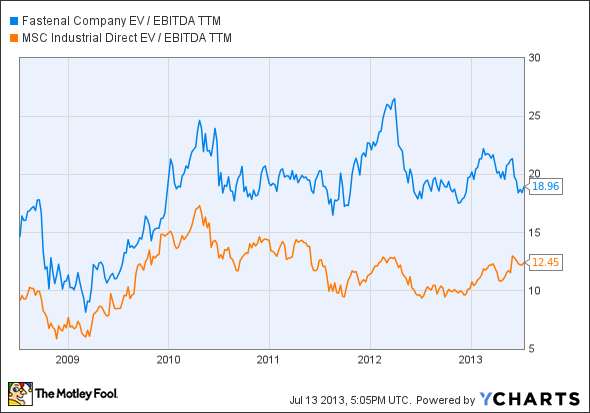
In comparing the two companies, MSC Industrial comes out on top in terms of valuation and potential to grow earnings despite the economic cycle.


FAST EV / EBITDA TTM data by YCharts

The bottom line

In conclusion, these results told similar story to the first quarter's about MSC and Fastenal and their end markets. It appears that Alcoa’s optimism is more related to the strength of some of its particular industry segments, such as aerospace and automotive. Investors in Fastenal and MSC would do well to ignore Alcoa and focus more on the ISM numbers in order to see where prospects for the two companies are headed.

Alternatively, there is a strong case for simply staying invested within the areas of strength in the industrial sector. It’s too early to proclaim a general second half pick-up.

Tuesday, June 4, 2013

Time to Buy Autodesk?

There have been two major themes to the first quarter reporting season. The first is that tech spending has been weak across the board, and the second is that--outside of pockets like aerospace and automotive--the industrial sector has been weak too. Cue Autodesk’s latest set of results. It’s a software company and its end markets are industrial. The rest is history--the company's results were disappointing and it guided lower. What's next for Autodesk, and what do its latest results say about the industrial sector?

Autodesk’s first quarter results

I have previously covered the stock, and those wanting to assess the migration of its earnings can get some background information on the company there.

 A brief look at Autodesk's first quarter numbers versus its internal guidance:

  • first quarter revenue of $570 million vs. internal guidance of $570-590 million

  •  first quarter earnings-per-share of $0.42 vs. internal guidance of $0.41 to $0.46

  • second quarter revenue guidance of $550 to $570 million vs. analyst estimates of $583 million

  • second quarter EPS guidance of $0.39 to $0.44 vs. analyst estimates of $0.45

  • Full-year revenue guidance of $2.38 billion vs. analyst estimates of $2.45 billion

The end result is that the company's revenues and earnings for the first quarter came in at the bottom end of guidance, and its future projections were lower than analyst estimates. I appreciate that the lowered guidance may appear to be somewhat easier for the company to hit, but I want to demonstrate how even this might prove tough.

Assuming that the mid-point of the second quarter guidance is hit, the remaining $1.25 billion in revenues that were forecast by Autodesk could be split up in the following manner. I note that the management stated that fourth quarter growth would be stronger than that of the third quarter, so some back-of-the-envelope revenue estimates of $593 million and $658 million for the third and fourth quarters respectively could be implied. I want to graphically demonstrate what this means to the back end of 2014’s revenues.


Looking at it, reaching these goals seems like a fairly big ask. The company was duly forced to spend significant time during its conference call discussing various reasons why targets like these might be feasible.

Can Autodesk hit guidance?

The main reasons that Autodesk gave to indicate that it can hit its (lowered) full year guidance are:

  • Its business is becoming more back-end loaded with its major account business. As this was an area of weakness in the first quarter, the numbers are expected to contribute more in the second half.

  • Autodesk argued that $24 million of growth for the first half of 2014 was pulled into the fourth quarter 2013, resulting in somewhat distorted seasonality for 2014.

  • The comparisons from the second to fourth quarters of last year are a lot easier to beat.

  • The ongoing transition in its business model towards selling software as a service (SaaS) suites (bundled software packages) rather than standalone flagship products should drive growth in the second half. This is similar to he way that Adobe Systems  is shifting its customers to SaaS-based solutions instead of standalone software.

  • Autodesk sees improved strength in certain sectors of the economy that heavily use its software, such as global commercial construction. The company is also making progress in expanding its automotive accounts.

There are notes of caution against this, of course:

  • The company reported that April is weak. With other manufacturing exposed companies like Fastenal and MSC Industrial Direct reporting weak numbers before April, this is not a good sign for the second quarter.

  • Despite the second quarter of last year being relatively weak, the guidance for the second quarter of 2014 is not great.

  • Emerging markets underperformed in the quarter. These markets are supposed to be a long-term growth driver for the company.

  • Suite sales in emerging markets have been a bit disappointing, and piracy remains an issue.

  • The transition to SaaS is making the company's revenues harder to predict, and with companies like Adobe shifting sales models towards SaaS and subscription-based sales it is causing some hesitation in the purchasing habits of customers.

Essentially, the manufacturing sector has been weak as both Fastenal and MSC Industrial confirmed in their earnings reports that are discussed here. Both companies have limited visibility and short sales cycles. MSC saw sequential weakness in the quarter to the end of March, and with Autodesk saying that its April got weaker then this is hardly good news for MSC.

It was a similar story with Fastenal, though interestingly it saw stronger results in its metal work operations. I think this is partly due to having more exposure to aerospace and automotive. Investors in the industrial manufacturing sector should watch the statements of these two companies quite closely while also keeping an eye on the ISM numbers.

As for Adobe, its shift looms large in Autodesk’s thinking because the former has started to regenerate growth in its core product range thanks to the shift to SaaS and subscription-based sales. At some point Autodesk may well emulate Adobe’s model of ending perpetual license sales (which will cause some short-term revenue shortfalls as customers shift), but until then we shouldn’t model too much of these effects onto Autodesk’s numbers. Prospects for Adobe look good in the mid-term but will it hit is (raised) expectations this year, bearing in mind how many other tech companies have warned in the first quarter?

Where next for Autodesk?

In conclusion, I think that it makes sense to wait for more evidence of a pick-up in general industrial conditions before buying into Autodesk. I've no doubt that many will be tempted into buying in after the fall as this has been a good tactic this quarter, but cautious investors may want to wait to avoid buying in while the stock still has room to fall.

Friday, April 26, 2013

General Electric Reports Mixed Results

Anyone who has watched the classic sales movie Glengarry Glen Ross or worked in sales will know that the acronym ‘ABC’ stands for ‘always be closing.’ However anyone who hasn’t and instead has solely listened to US blue chip conference calls over the last few years will probably conclude that it actually stands for ‘always be cost-cutting.’ In other words, investing for growth is still on the back-burner in favor of pruning and consolidating measures made in light of uncertain end demand. Such considerations came to mind when considering General Electric’s $GE latest results.

A mixed Industrial Environment

The earliest indication of how the industrial sector was faring was outlined by Alcoa $AA recently, and it was pretty positive in my view. Other than a slight weakening of its European automotive outlook, Alcoa kept its end markets prognosis constant. However, on closer inspection it is clear that Alcoa’s growth prospects in 2013 are highly reliant upon China. In addition it is exposed to a few industries that are doing relatively better.

As this article demonstrates, global aerospace is doing well with airlines surprising on the upside and passenger growth numbers growing at a decent clip. This is obviously good news for General Electric and its aviation segment. In addition, Alcoa’s North American outlooks for its automotive and commercial building & construction segments respectively were for 0-4% and 1-2% with China growing up to 10% in both. Europe is expected to decline in both of these segments. So while China is doing well and some global industrial sectors are doing okay, it is far from a universal situation.

More evidence of this divergence in the industrial sector can be gleaned from looking at what the industrial suppliers like Fastenal and MSC Industrial are saying. Aerospace and auto are fine but elsewhere there was weakness in Q1.

What GE Said

Fast forward to GE’s latest results and the company reported that its industrial segment profits were $200 million lighter than had been expected largely due to Europe being weaker than forecast. The power & water segment was particularly affected while elsewhere GE reported some reluctance to close orders in a few of its shorter cycle industries. Again, the latter statement correlates with what the industrial suppliers (who are as about as short cycle as you can get) indicated.

In order to see the relevance of the power & water segment here is a breakdown of GE’s segmental profitability in the quarter.


As the chart indicates the industrial segments that increased profitability were aviation, healthcare and transportation. GE capital profits improved in line with its rationalization strategy. Overall segment profits were down 4%, but net earnings rose 16% thanks to lower charges and eliminations.

See what I mean about ABC? Indeed, the immediate response to the weakness in the quarter was to announce more cost cutting measures. Plus ca change and all that.

What the Results Mean to The Market

Another area of interest was US healthcare, which GE said was a bit weaker than expected. Investors got an early read on this when Johnson & Johnson gave results and noted (within its medical devices and diagnostics segment) that US hospital procedures were weaker than the hospitals had forecast going into 2013. In addition hospital spending wasn’t as strong. It’s nothing dramatic for Johnson & Johnson because it has plenty of other profit drivers within pharma and consumer products, but for a company like Varian Medical Systems $VAR it is a cause for concern.

I like Varian, and based on a SWOT analysis think it has some very impressive long term growth prospects with its proton therapy solutions. In the near term it can expand its radiation therapy into indications like lung cancer, particularly within emerging markets. In addition its new deal (GE was its former partner) with Siemens (which is pulling out of radiation oncology) gives it a large installed base on which to target. On the other hand its systems require significant outlays, and with Johnson & Johnson and GE reporting some weaker conditions, can we really expect immediate upside from Varian?

On a more positive note GE forecast that its oil & gas and home & business segments are going to be ‘pretty solid’ for the year. Within the latter segment one of its key rivals is Whirlpool $WHR I think Whirlpool has good growth prospects in 2013. The US housing market is recovering, and Whirlpool is starting to anniversary the housing boom of 10 years ago. In other words, the white goods purchased back then should have depreciated by now and a replacement cycle should kick in. Furthermore, GE reported good results in emerging markets so we have reason to believe that Whirlpool will do okay in its key Brazilian market.

Where Next for GE?

Cost cutting isn’t sexy, but it does represent a key bottom line opportunity for GE this year. Europe was weaker than expected but China’s strength was a welcome positive note. As noted above GE’s end markets will be variable this year with areas like aviation, transportation and health care (especially in emerging markets) likely to remain strong and counteract areas more exposed to austerity measures like US military spending and European infrastructural spending.

Investors looking for a more focused exposure to their favorite end markets will not buy GE because of its diversification, but those looking for a 3.5% yielding global GDP type play will view this mini sell-off as a buying opportunity.

Thursday, October 13, 2011

Fastenal Confirms US Construction Acitivity is Solid


Fastenal $FAST gave earnings and demonstrated good growth. The Fastenal story is a good one and stock investors can find a detailed write up and earnings analysis of the company’s fundamental evaluation in the link at the bottom. However, for now the important thing to takeaway from Fastenal’s earnings report is that-if the US was in isolation- a double dip recession looks unlikely. Fastenal is a good company to look at because it sells the kinds of fasteners and hardware equipment that are used in construction activity.

The best way to conclude this from the results is to look at the sales figures for stores that have been open for more than five years. These stores tend to be more cyclical in their revenues because they are more mature in their market share within their local markets. Here are the numbers for revenue growth…


Jan.
Feb.
Mar.
Apr.
May
June
July
Aug.
Sept.
Oct.
Nov.
Dec.
2011
15.3%
17.9%
19.2%
19.1%
17.9%
18.2%
17.3%
15.2%
14.5%


2010
-2.1%
-0.5%
7.4%
14.9%
17.3%
16.2%
19.8%
18.2%
18.9%
17.9%
13.2%
16.0%
2009
-12.4%
-14.3%
-21.5%
-25.2%
-25.2%
-26.3%
-26.6%
-24.7%
-24.2%
-21.7%
-15.0%
-12.1%


…and it is clear that US construction activity hasn’t fallen off a cliff just yet!


Further Reading
http://earningsview.blogspot.com/2011/01/fastenal-set-for-good-growth-but-what.html

Wednesday, January 19, 2011

Fastenal Set for Good Growth but What About the Evaluation?


Hardware wholesaler and retailer Fastenal gave results recently and, the market bid the stock down, they beat on revenues but earnings were slightly shy. For Q4 Fastenal reported revenues of $573.8m and EPS of 44c. Analysts forecasts were for $563m and 45cents respectively.

Before I get into more detail on Fastenal, I want to outline the Co’s main objectives as laid out in the ‘pathway to profit’. I do these write-ups to serve as a reference point for future research and I find this sort of benchmarking useful.


Fastenal Pathway to Profit

This is a set of strategic end points that was originally laid out in 2007, but it has seen adjustment due to the effects of the recession.

  1.  to continue growing our business at a similar rate with the new outside sales investment model
  2. to grow the sales of our average store to $125 thousand per month in the five year period from 2007 to 2012
  3. to enhance the profitability of the overall business by capturing the natural expense leverage that has historically occurred in our existing stores as their sales grow, and
  4. to improve the performance of our business due to the more efficient use of working capital (primarily inventory) as our average sales volume per store increases
  5. 85% of earnings in operating cash flow

As a consequence of the recession the Co reduced the growth of new store openings and headcount additions. Furthermore in 2010, Fastenal pushed out the $125k a store target until 2014 but announced that it was possible to hit the profit objectives (23% operating margin) anyway, thanks to cost cutting.


Scorecard on the Pathway to Profit

Firstly, I want to outline how Fastenal is now increasing the share of sales force outside the store…


Q1 2007
Q3 2008
Q4 2009
Q1 2010
Q2 2010
Q3 2010
Q4 2010
Store Personnel
6383
8280
7007
7004
7118
7450
7611
Non-Store Sales
616
599
597
594
591
639
712
Percentage
8.8
6.7
7.9
7.5
7.7
7.9
8.6
 source: Fastenal, Earnings View

Secondly, as discussed earlier the aim of sales of $125k per month per store has been pushed out by two years but, they think they can hit the 23% operating margin target early.

Thirdly, the development of leveraging up on sales has been held back by the recession. I want to highlight the percentage of pre-tax profits generated by stores with sales of over $100k a month.


Stores Selling over $100k per month
2008
2009
2010
Percentage of Stores
20.7
12.7
19.1
Percentage of Pre-Tax Profits
53.3
48.8
52
 source: Fastenal, Earnings View

Again, there is a return in the numbers but they are still not back to 2008

Fourth, looking at working capital as a percentage of sales tells a similar story.


2008
2009
2010
Accounts Receivable
244940
214169
270133
Inventories
564247
508405
557369
Working Capital
809187
722574
827502
WC/Sales %
34.6
37.4
36.5
source: Fastenal, Earnings View 

In essence, Fastenal have been held back from achieving the ‘pathway to profit’ objectives but look set to get there in future.


Fastenal End Demand is a Combination of Industrial and Residential Construction

In these results, Fastenal has benefited most strongly from a cyclical recovery in industrial production and less so from ongoing demand from maintenance. However, commercial residential construction customers (which usually represent 20-25% of their business) are still in a funk, despite the recorded growth. I would guess that this growth is coming of a very low base and, until the US housing market recovers, it will not come back in a meaningful way.


Fastenal Revenue Growth

On the conference call, Fastenal argued that

‘think it's a reasonable target. Some of the puts and takes would be if you look at the historical patterns, we normally touch start our January at or above where our October daily average was, which puts us in the 20% range in January. If you start out there, even if it slowed down a little bit, you should be able to hit the 15% to 20% for the year. Right now, we do not predict that it will be slowing down. So we're pretty confident in the 15% to 20% sales range at this point.’
Looking at the October number for stores opened for more than two years, it is 18.8% growth. Considering that most analysts have 2011 GDP growth to be similar to 2010, they could hit this again in 2011. Moreover, they are opening 150-200 new stores in 2011. Assuming $10k per month for 175 stores over the year gives another 21m or about .9% to 2010 revenues. Adding these two numbers together gives 19.7% for the year.

On top of that, 2010 saw very weak housing starts data. I think this will continue into 2011 as there remains a substantial amount of shadow inventory. However, the market has stabilised and I think there could be stronger activity in the second half. In addition, increasing employment and discretionary spending should aid Fastenal. I think they could achieve 16% revenue growth next year. I’ve shaved off 2% points to reflect on the slowing in the rate of growth of industrial investment spending.


Fastenal Evaluation

This would give $2.62bn in sales, which could give $2.20 in EPS or $324m in net earnings. If operating cash flow is again around 85% this gives $275m in operating cash flow, if capex is around $70m (new stores etc) this gives $205m in free cash flow.

I would want to buy it at a forward FCF/EV of around 4% which would give it a share price of $35. I find myself in a curious position of thinking forecasts are too light but that the company is overvalued. Frankly, I don't buy the analysts forecasts of 20% growth for next five years. Fastenal maybe recovering, but we are not going back to a housing boom anytime soon.