Showing posts with label novartis. Show all posts

Monday, December 30, 2013

Cooper Companies Offers Great Long Term Prospects

In a world where investors make knee-jerk reactions to the latest quarterly earnings reports, it's sometimes difficult to focus on the long term. In the case of the soft contact lens industry, Foolish investors are faced with an industry with pretty secure long-term growth prospects. The only significant players are Johnson & Johnson and Novartis'  Ciba unit, with Cooper Companies  coming in third. Meanwhile, Valeant's  2013 acquisition of Bausch & Lomb puts it in fourth place. Cooper is the closest to a pure eye-care play among them, and it presents an interesting proposition for long-term buy-and-hold investors.

Cooper Companies' long-term growth
According to independent analysis, the soft contact lens industry is intended to grow at a rate of nearly 6% from 2012-2016. Indeed, Cooper companies reported that worldwide industry growth was at 5% this year. However, its CooperVision unit (around 80% of revenue, with CooperSurgical making up the rest) reported soft contact lens sales up at a more impressive 10% this year.

Essentially, CooperVision has the opportunity to grow faster than the market for four key reasons.

First, Cooper's silicone hydrogel (more comfortable, longer-lasting) lens sales grew at 19% (constant currency) in the fourth quarter, and are set to grow faster than the market. Moreover, since silicone hydrogel lenses make up 45% of its CooperVision's total revenue, Cooper can grow ahead of the market. In particular, its Biofinity (monthly, silicone hydrogel) lens has a growth opportunity in the US from customers trading up.

Second, industry wide single-use lens sales grew at 10% over the last 12 months, and CooperVision's single-use lens sales increased by 18% (constant currency) over the last year. They made up 21% of CooperVision sales in the fourth quarter. Going forward, Cooper is gearing up for an aggressive expansion of its MyDay (daily, silicone hydrogel) lens in Europe. Customers trading up to its single-day lens generate four to six times more revenue and three to five times more profit. In other words, Cooper has a revenue and margin expansion opportunity with MyDay, but it will take a few years to come to fruition.

Third, Cooper's specialty lenses (toric and multifocal) grew at 8% and 19% respectively in the fourth quarter, and now contribute nearly 40% of CooperVision revenue.

Finally, CooperVision's Asia sales grew at 11% (constant currency), and Cooper's management claims to have good growth opportunities with its Biofinity lens.

All told, it's not hard to see why analysts have the company growing revenue at more than 7% for the next few years.

Johnson & Johnson, Novartis and Valeant report
With a 43% share of the market, Johnson & Johnson is the No. 1 player, but its growth in the third quarter was a far more pedestrian 3.9% (constant currency). Moreover, its U.S. sales only grew 1.9%. Johnson & Johnson has a dominant market position in the two-week modality in the US and this may prove difficult to defend in future, as single-usage lenses gains popularity. 

Novartis operates Ciba Vision (25% of total market) out of its Alcon division, and its contact lens revenue was up 6% (constant currency) in the third quarter with growth driven, unsurprisingly, by its daily lenses and silicone hydrogel lens called AirOptix. Meanwhile, Valeant's Bausch & Lomb (9% market share) launched a one-day lens this year, but the parent company's main focus is on integrating the eye-care company and cutting costs. Indeed, Valeant is expected to reduce Bausch & Lomb's workforce by up to 15% going forward, while it seeks to expand internationally.

In a sense, Cooper's growth prospects (single-use, silicone hydrogel and international expansion) are nicely mirrored in what its rivals are saying too.

Cooper's bumpy growth
While Cooper's prospects look assured, the growth ahead won't be in a straight line. For example, management was very clear on the conference call that it was willing to invest in building out capacity for the growth of MyDay. According to CEO Robert Weiss:

 it is unlikely we will be making profits on MyDay in the next several years with the intent of continuing to develop that franchise, continuing to drive down cost of goods... ...capacity increases behind the product once we come to the U.S. and then... ...other markets around the world

Ultimately, it's not clear how this will affect profitability over the next few years. Moreover, international expansion comes at a cost, and Cooper predicts capital expenditures at a historical high of $200 million (nearly 12% of projected revenue) for next year.

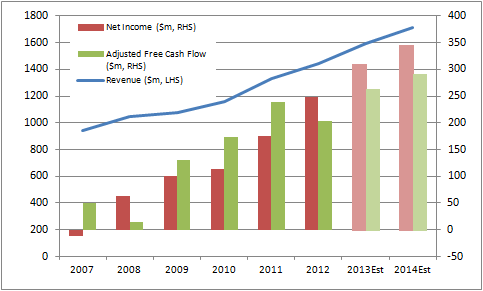
A look at its historical performance demonstrates that Cooper can grow revenue in a recession (note its 2008-2010 performance) and its adjusted free-cash flow (calculated by assuming capital expenditure is equivalent to depreciation) is quite strong.

Sources: Company presentations, author's estimates.

Time to buy Cooper Companies?
Cooper's aim is to hit 25% operating margins by 2018. Assuming it does so, and revenue grows at 7%, then operating income is likely to be $560 million or 71% higher than it is now. In other words, operating income looks set to grow in excess of 11% a year compounded.

That's not astonishingly cheap for a company generating around 4.4% of its enterprise value in adjusted free-cash flow. However, Cooper is a relatively recession-resistant company, and Foolish investors should be willing to pay a premium for this quality. It's a good stock for long-term investors, but don't expect the ride to be plain sailing all the way.

Monday, October 14, 2013

Cooper Companies, Great Prospects, Expensive Stock

When it comes to investing, sometimes it's best to start with the obvious and look for companies that have the potential to slowly grow. Contact lens specialist Cooper Companies  (NYSE: COO  ) is one such stock, and it's definitely worth taking a closer look at it.

Cooper Companies growth prospectsCooper reports numbers in two separate segments. CooperVision is a soft contact lens manufacturer generating 80% of revenues. CooperSurgical generates 20% of revenues, with two-thirds coming from surgical devices, and one-third from its fast growing fertility treatment products.  I'm going to focus on CooperVision.

Cooper's management is on record as expecting the soft contact lens market to grow at a 4%-6% clip this year. The bad news is that, for a second quarter running, the worldwide market only grew at 4%. This suggests that market demand is not as strong as it could be.

The good news is that CooperVision managed to grow its sales by 11% over the last 12 months, and there are a number of reasons why it can continue to grow.

First, its silicone hydrogel lenses (more comfortable, last longer) revenues now make up 43% of CooperVisions total. They grew at 22% (constant currency) in the last quarter, and Cooper can expect to generate more growth in the future from customers "trading up" to these lenses.

Second, Cooper's management never tires of pointing out that a customer trading up to its single-use (or one-day) lenses generates four to six times more revenue and three to five times more profit. In other words, there is ample room for growth in earnings and margin growth from expanding one-day sales. For reference, its single-use sphere revenues only make up 21% of CooperVision revenues (17% of total company), and they grew at 9% in constant currency in the last quarter.

Third, Cooper plans to move in on Johnson & Johnson's (NYSE: JNJ  ) dominant position in the two-week modality in the U.S. by marketing its own two-week lenses.

Fourth, Cooper has just launched its new branded one-day silicone hydrogel based lens called MyDay in Europe. According to the management, MyDay is "not going to be a major influence" next year because sales are building from a small base. It will take Cooper time to build up production capacity, but longer-term Cooper should have good prospects with MyDay. 

And finally, Cooper has plans to geographically expand sales of its leading Biofinity (monthly silicone hydrogel lenses). Moreover, it can cut costs thanks to not paying royalties, because sillicone hydrogel patents will expire in the U.S. in 2014 and globally in 2016.

Threats to growth?While Cooper has been growing, there is no guarantee that it will continue to do so. Indeed, Valeant Pharmaceutical's (NYSE: VRX  ) purchase of Bausch & Lomb suggests that competition will get tougher. For example, Bausch & Lomb recently launched a one-day lens. Moreover, Valeant has worldwide plans to generate synergies between its existing dermatology and eye-care products, and Bausch & Lomb's eye-care solutions. Valeant will surely invest in trying to expand Bausch & Lomb's international sales.

Similarly, Johnson & Johnson managed to accelerate growth in its vision-care segment to 5.4% operationally in the last quarter, and it cited its one-day lenses as one of "the primary contributors to operational growth." Cooper is not alone in recognizing the margin potential of one-day lenses, and Johnson & Johnson has a formidable distribution network in the kinds of emerging markets that Cooper wants to expand into.


A look at the numbersCooper has strong prospects, but it also has a strong valuation. Cooper's own EPS guidance has increased throughout the year.


Source: Company presentations.

However, its valuation has more than kept pace, and it now sits on a forward P/E of over 20 times the mid-point of its full-year EPS guidance. This looks expensive, but recall that Cooper has long-term margin expansion opportunities. Furthermore, a better gauge of its value is to look at its free cash flow potential. I've chosen to adjusted for the increased capital expenditure program it's undertaking right now. Cooper is investing in order to develop production capacity and to accelerate sales of its silicone hydrogel based sales. 

In the following table, I have assumed that capital expenditures equate to depreciation in order to give a better picture of underlying cash flow generation.


Sources: Company releases, author's estimates for 2013 and 2014.

My underlying free cash-flow estimates of $264 million and $290 million for the next two years indicate that Cooper continues to generate plenty of cash. However, these figures represent only around 4% and 4.3% of its current $6.65 billion enterprise value.

Cooper is an attractive company, but its valuation gives little room for error, and it operates in a very competitive market against giants like Johnson & Johnson and Novartis (Alcon). It's a great company, but one to keep on your watchlist for now.

Monday, June 17, 2013

Cooper Companies Has Good Long Term Prospects

Everyone loves a defensive growth story, and there aren’t many better companies in the category than Cooper Companies (NYSE: COO). In general, ophthalmology is an industry that can grow irrespective of the economy. Within this, Cooper has its own mix of earnings drivers with which it can generate superior industry growth.

It is a compelling mix. In fact, so much so that the stock has gotten away from this investor’s hopes for a buying opportunity. In summary, the recent results were pretty good in a relatively weak environment, and the full year EPS guidance hike is seeing the stock higher as I write. Is there more to come?

Super Cooper

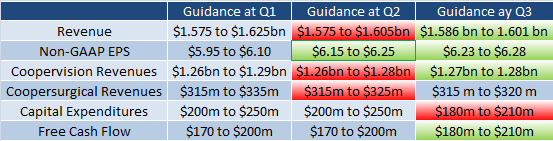
Before going into the details, here is a summary of the updated full year guidance versus the previous company estimates.


The key changes are the raising of EPS guidance (I have bracketed) and a $10 million lowering of revenue guidance for Coopervision and Coopersurgical respectively. The former is largely due to currency effects and the latter is due to the kind of softness with medical surgery that others like Johnson & Johnson (NYSE: JNJ) have reported in the quarter.  In fact, Johnson & Johnson explicitly stated that hospitals had reported that surgical procedures were currently running at levels below the rate that they had predicted for 2013. As for the full year currency effects on Coopervision, we got an idea of how pervasive they are in the current quarter whereby 11% growth at constant currency turned into only 7% reported growth.

So while the reduction to revenue expectations was slightly disappointing, the increase in the EPS guidance was well received. There was no change to free cash flow (FCF) guidance.

Essentially Cooper is succeeding in its aims of trading up customers to its (higher margin) silicone hydrogel lenses (which now make up 43% of Coopervision revenues) and towards its one-day modality. The latter generates 4-6x the revenue of ordinary lenses and 3-5x the profit. All of which is good news because if we go back to the previous set of results Cooper outlined its intention to increase capital expenditures by $90 million in order to accelerate the sales expansion of its silicone hydrogel based lenses. The recent results suggest that it was a good move.

Long term growth looks assured

Going forward the long term opportunity for Cooper is obvious. The company is catching up with its rivals in terms of its silicone hydrogel lens penetration, and the benefits of a one day modality to the consumer are obvious. Moreover, unlike some of its rivals, Cooper is not encumbered with the strategic difficulty of missing out on lens care sales (one day lenses don’t require care) because it is expanding its one day sales. Furthermore it can expand its private label sales, and the growth potential in the emerging world is obvious.

However, the story isn’t just about Coopervision. Its surgical division is a strong FCF generator, and the strategy is to make further acquisitions in the space in order to leverage its sales infrastructure. Putting all these elements together should ensure long term growth and, more importantly, at a rate in excess of industry growth.

What the industry is saying

Cooper reported that the market only grew 4% (at the bottom of the expected 4-6% range) and that it expected it to grow at 4-6% for the rest of the year. The good news is that Cooper is able to grow in excess of these numbers. A quick look around the industry shows some sluggish conditions. Its biggest rival is probably Johnson and Johnson, and it reported only 1.6% constant currency growth for its vision care range; thanks to currency effects its international vision care was down 4.4%.

It was a similar story with Novartis’ (NYSE: NVO) Alcon unit. Ophthalmic pharmaceuticals sales were up 5%, but vision care was only up 3% and, in line with what Johnson & Johnson and Cooper said, its surgical revenues were soft with only 2% growth being recorded. Alcon is not a huge part of Novartis' revenues, but it is of strategic important to the company and complements its generic and OTC pharmaceuticals activities.

However, the big news in the industry in the quarter was Valeant Pharmaceuticals' (NYSE: VRX) agreement to purchase Bausch & Lomb for $8.7 billion. It is certainly a busy time for Valeant as it attempts to integrate Medicis as well as prepare for Bausch & Lomb. Interestingly Valeant disclosed that Bausch & Lomb grew revenues at 9% last year (although this includes its surgical segment). Valeant talked about generating $800 million in cost synergies by the end of 2014, but this does not mean it won’t be investing in eye-care. In fact Bausch & Lomb’s strength in emerging markets is complimentary to Valeant’s North American focus, and eye-care, dermatology and aesthetics are good bed-fellows in terms of strategic development. We can expect increased competition as a result of this deal.

I would summarize the industry background as being stable but slightly weaker than might have been expected.

Where next for Cooper Companies?

In conclusion Cooper Companies is a very attractive company that can achieve good revenue and margin growth even if the economy slows. In my opinion its evaluation should command a premium over the market but, as ever, the question is how much do you want to price in?  The ‘defensive’ sector has certainly led the market this year, and many stocks within it (particularly food stocks) are starting to look toppy to me.

As I write this, Cooper Companies trades on $120 and an enterprise value (EV) of $5.85 billion. Interpolating from my table above, this puts it on a forward PE ratio of 19.3x and a forward FCF/EV yield of only 3.1%. As much as I like the stock I am still going to truculently go away, sit in a corner and mumble that it’s too expensive right now while patiently waiting for a dip.

Friday, January 14, 2011

Vectura and SQS Give Positive Updates

It's always nice to start the day with a couple of very good updates from your holdings. In this case it SQS Software's trading statement and a seemingly innocuous presentation from Vectura which actually, I believe, contains some potentially very good news.


Vectura VR315 US Licensing Deal?

Last year, after Novartis' Sandoz decided to hand over US deployment for VR315 (believed to be generic Advair) the share price immediately slumped over 20%  In addition, analysts called into question the commercial potential of VR315 in the US and, the possibility that it had been dumped in regulatory concerns. Whilst Novartis (Sandoz) continued to work with Vectura in VR315 for Europe, this update to the States effectively led to the market writing off VR315 in the US.

All of which, lead me to be optimistic over the statements made yesterday in a Vectura presentation at the 29th JP Morgan Healthcare Conference in San Francisco. You will find them at around 10:30 in the broadcast. I have replicated them here...
315 is not just a European asset, it's an asset that is going to be of value in both the rest of the World and US territories. We are currently negotiating and a late stage negotiations for  rest of the world with several players, with several players, and in the United States we have a great deal of interest and our advanced stage discussions, and deep into due diligence with a lead company, a lead company with whom, we feel very confident we can take this product forward

So it seems that a US deal is close! I hadn't heard anything about this -in such candour-before and think that we are headed higher when/if a deal gets done.


SQS Software Systems AG Trading Update

A very strong update. Adjusted profit before taxes is expected to be broadly in line with consensus. This is ok, however consider that
  • there is a deferral of E500k of budgeted high margin software sales into 2011
  • revenues for 2010 are expected to be ahead, due to winning Managed Services contracts
This means that the 2011 revenue and profit forecasts will probably need to be upgraded by analysts due to the E500k deferral of sales. Moreover, the managed services contracts won in 2010 tend to be low margin at the outset. This means that in 2010 they have seen a slight shift of high margin work (software sales) in to 2011 and taken on some initially lower margin work, yet they have hit consensus profit estimates.

I suspect this means that margins are caeteris parabus ahead of estimates. The managed services contracts give greater visibility and long term earnings and I would expect a re-rating after this statement.

I hold both these stocks.